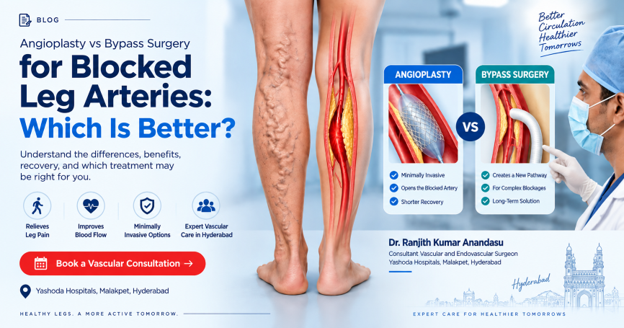
Angioplasty and bypass surgery are both established treatments for blocked leg arteries, but neither is universally better. The right option depends on the location and severity of the blockage, blood flow to the limb, symptoms, vascular anatomy, overall health and treatment goals.
For people searching for blocked leg arteries treatment in Hyderabad, understanding the difference between angioplasty and bypass surgery can help them have a more informed discussion with a vascular specialist.
-
Quick Answer: Angioplasty or Bypass Surgery?
Angioplasty is a minimally invasive treatment that can improve blood flow through suitable narrowed or blocked arteries. Bypass surgery creates a new pathway around a blocked artery and may be considered for selected patients with extensive or complex disease.The choice should be based on clinical examination and appropriate vascular imaging rather than simply choosing the less invasive or newer procedure.
-
What Are Blocked Leg Arteries?
Blocked leg arteries are commonly associated with peripheral artery disease (PAD). PAD develops when plaque builds up inside the arteries, reducing blood flow to the legs and feet.Common symptoms include:
Pain or cramping while walking
Leg heaviness or weakness
Cold feet
Numbness or tingling
Changes in skin colour
Slow-healing wounds
Foot or toe ulcers
Pain at rest in advanced disease
A sudden reduction in blood flow with severe pain, a cold or pale limb, numbness or weakness can indicate an emergency and requires urgent medical attention.
-
What Causes Artery Blockage in the Legs?
Atherosclerosis is a major cause of peripheral artery disease. Risk factors include:Diabetes
Smoking or tobacco use
High blood pressure
High cholesterol
Increasing age
Kidney disease
Family history of cardiovascular disease
Managing these risk factors is an important part of vascular care.
-
How Are Blocked Leg Arteries Diagnosed?
Diagnosis usually begins with a medical history and physical examination. Your vascular specialist may check pulses, skin changes, temperature and wounds.Depending on your symptoms, tests may include:
Ankle-brachial index (ABI)
Doppler or duplex ultrasound
CT angiography
MR angiography
Catheter angiography in selected cases
These investigations help determine where the blockage is located, how extensive it is and whether revascularization may be beneficial.
-
What Is Angioplasty for Blocked Leg Arteries?
Peripheral angioplasty is a minimally invasive procedure used to improve blood flow through a narrowed or blocked artery.A thin catheter is guided to the affected artery. A small balloon may be inflated to improve the opening within the vessel. In selected cases, a stent may be placed to help maintain blood flow.
Because angioplasty is performed from inside the blood vessel, it generally avoids the larger incision associated with open bypass surgery.
Potential Benefits of Angioplasty
For appropriately selected patients, angioplasty may offer:
A minimally invasive approach
Smaller access site
Less surgical trauma
Potentially faster recovery than open surgery
An option for patients who may have higher risk from open surgery
However, not every blockage is suitable for angioplasty. The length, location, calcification and complexity of the disease are important considerations.
-
What Is Bypass Surgery for Blocked Leg Arteries?
Peripheral artery bypass surgery creates a new route for blood to flow around a severely narrowed or blocked artery.A suitable vein or vascular graft is used to create an alternative pathway beyond the diseased section.
Unlike angioplasty, bypass is an open surgical procedure. It can be considered for selected patients with extensive or complex disease or when the arterial anatomy is more suitable for surgical treatment.
Bypass remains an important option for selected patients with advanced peripheral artery disease.
-
Angioplasty vs Bypass Surgery: Key Differences
Approach: Angioplasty – Minimally invasive/endovascular; Bypass Surgery – Open surgery
Main principle: Angioplasty – Opens or treats the blocked artery; Bypass Surgery – Creates a new route around the blockage
Incision: Angioplasty – Small access site; Bypass Surgery – Larger surgical incision
Stent: Angioplasty – May be used when appropriate; Bypass Surgery – Not the primary treatment
Recovery: Angioplasty – Generally shorter; Bypass Surgery – Generally longer
Suitable for: Angioplasty – Selected arterial disease; Bypass Surgery – Selected extensive or complex disease
Surgical burden: Angioplasty – Usually lower; Bypass Surgery – Greater
This comparison is general. The appropriate procedure depends on the individual patient's condition.
-
Which Is Better: Angioplasty or Bypass Surgery?
There is no single answer that applies to every patient.Angioplasty may be appropriate when the blockage has anatomy suitable for an endovascular approach. It can be attractive when a minimally invasive treatment is preferred or when open surgery presents greater risk.
Bypass may be more appropriate when disease is extensive or complex, when the anatomy favours surgery, or when an endovascular approach is unlikely to provide an adequate result.
The decision can depend on:
Location and length of the blockage
Degree of arterial calcification
Blood flow beyond the blockage
Severity of symptoms
Presence of ulcers or tissue loss
Previous vascular procedures
Overall health and surgical risk
Availability of a suitable vein or graft
Therefore, angioplasty is not always better than bypass, and bypass is not always better than angioplasty.
-
Can Blocked Leg Arteries Be Treated Without Open Surgery?
Yes, in appropriately selected patients.Peripheral angioplasty and stenting can improve blood flow without conventional open bypass surgery.
However, not every blockage can or should be treated with angioplasty. Some patients may benefit more from bypass or another treatment strategy.
A vascular specialist should evaluate the imaging and clinical condition before recommending a procedure.
-
Does Everyone With PAD Need Angioplasty or Bypass?
No. Not every person with peripheral artery disease needs a procedure. Depending on the severity of symptoms and disease, treatment may include:Smoking cessation
Diabetes management
Blood pressure and cholesterol control
Prescribed medications
Structured exercise when appropriate
Foot care
Regular medical follow-up
Revascularization may be considered when symptoms remain significantly limiting despite appropriate treatment or when there is limb-threatening ischemia.
-
What Happens If a Blocked Leg Artery Is Not Treated?
The outcome depends on the severity of the disease.Some people have stable PAD that can be managed with medical treatment and lifestyle measures. Advanced disease can cause severe walking limitations, pain at rest, ulcers and tissue loss.
Severe loss of blood flow can threaten the limb. PAD is also associated with increased cardiovascular risk, so treatment should address overall vascular health rather than only the leg blockage.
-
Dr. Ranjith's Expertise in Vascular and Endovascular Treatment
Choosing between angioplasty and bypass requires careful assessment of both endovascular and open surgical options.Dr. Ranjith Kumar Anandasu is a Consultant Vascular and Endovascular Surgeon at Yashoda Hospitals, Malakpet, Hyderabad. His published qualifications include MBBS, DNB General Surgery and MCh Vascular Surgery, with extensive experience in vascular and endovascular care.
His practice covers conditions and procedures including peripheral arterial disease, angioplasty and stenting, open surgical bypass, thrombectomy and other vascular interventions.
For patients seeking a vascular surgeon in Hyderabad, access to both endovascular and open surgical expertise can be valuable when the appropriate treatment depends on the complexity and location of an arterial blockage.
-
How Can You Reduce the Risk of Further Artery Disease?
Long-term vascular health is important even after a procedure. Depending on your doctor's advice, this may include:Stopping tobacco use
Managing diabetes
Controlling blood pressure
Managing cholesterol
Taking prescribed medicines
Staying physically active
Maintaining a healthy weight
Checking your feet regularly if you have diabetes
Attending follow-up appointments
-
Frequently Asked Questions
Is angioplasty better than bypass surgery?
Not necessarily. Angioplasty may be suitable for some blockages, while bypass may be more appropriate for selected complex or extensive disease. The decision depends on anatomy, symptoms and overall health.
Which has a faster recovery: angioplasty or bypass?
Angioplasty is generally less invasive and often has a shorter recovery than open bypass surgery. Recovery varies depending on the procedure and the patient's health.
Can a completely blocked leg artery be treated with angioplasty?
Sometimes. Selected complete blockages can be treated using endovascular techniques, but suitability depends on the location, length, calcification and other anatomical factors.
When is bypass surgery recommended?
Bypass may be considered when disease is extensive or complex, when anatomy favours surgery, or when an endovascular approach is unsuitable or unlikely to provide an adequate result.
Can peripheral artery disease be treated without surgery?
Yes. Some patients can be managed with medication, exercise, lifestyle changes and control of cardiovascular risk factors. When revascularization is required, angioplasty may provide a minimally invasive option for suitable disease.
Can blocked leg arteries cause foot ulcers?
Yes. Reduced arterial blood flow can impair wound healing. A non-healing foot or leg wound, particularly in someone with diabetes or known PAD, should be evaluated promptly.
What are the warning signs of severe artery blockage?
Severe or worsening pain, pain at rest, a cold or pale foot, sudden numbness or weakness, or non-healing wounds can indicate serious circulation problems. Sudden loss of blood flow requires urgent medical attention.
Which doctor treats blocked arteries in the legs?
A vascular surgeon or vascular and endovascular surgeon evaluates and treats conditions affecting blood vessels, including peripheral artery disease and blocked leg arteries.
How do I choose a vascular surgeon in Hyderabad?
Look for a qualified vascular specialist with appropriate training and experience in both endovascular and open vascular procedures. The doctor should evaluate your individual condition and explain the available treatment options.
-
Conclusion
Angioplasty and bypass surgery are both valuable treatments for blocked leg arteries, but the best choice depends on the individual patient.Angioplasty provides a minimally invasive option for appropriately selected arterial disease, while bypass creates an alternative blood-flow pathway and remains important for selected patients with extensive or complex blockages.
If you experience leg pain while walking, persistent foot pain, cold feet, a non-healing wound or symptoms of poor circulation, seek medical evaluation rather than ignoring the problem.
For patients looking for blocked leg arteries treatment or a vascular surgeon in Hyderabad, Dr. Ranjith Kumar Anandasu provides vascular and endovascular evaluation and treatment, including angioplasty, stenting and bypass procedures.
This article is intended for general educational purposes and does not replace an individual medical examination, diagnosis or treatment recommendation. Treatment decisions should be made by a qualified vascular specialist after appropriate clinical and imaging evaluation.